Saturday, July 6, 2013

Nisyros - Simply Wonderful


Wednesday, July 3, 2012—Mandraki, Nisyros, Greece
Took the boat over from Kos to Nisyros two mornings ago. It was a good move: I had pretty much had my fill of Kos. Nisyros has turned out to be quite a nice stop. I came here, like most people do, to check out the semi-active volcano at the island's heart (which I did—it was interesting, if not mind blowing), but I'm glad I've stuck around. It's a truly beautiful place. Due to the the rich volcanic soils the island's very rich—its inland areas are teaming with plant life, both of the wild and the domestic variety; it's even more lush than Kos. It's also got a great climate. Due to it's small size (it's probably only around a quarter of the size of Kos) even inland you catch the coastal breezes, which are pretty strong, to the point where my first night here, when I was eating at a little restaurant right on the water, I felt the need to throw on a pullover because things were getting a bit chilly. It's also a very rugged island. I went hiking yesterday and found myself in an absolutely beautiful gorge, which, despite its rugged nature, was also one of the most fertile places I've been to in Greece. The hills there were lined with very productive terraces and on the way there I passed all sorts of different types of crops growing (plus of course many goats and sheep).

The town I'm staying in is the island's capitol, Mandraki. It's one of the cooler little towns I've run into in Greece. It clings to a very narrow, mostly rocky, coastal strip and climbs a fair way into the mountains. In regards to its layout it's your typical windy Greece village, but there's just something really nice about the place—it gives off a wonderful vibe. It's got its tourist shops, but not that many of them and the restaurants attract as many locals it seems as they do travelers. It's especially nice here in the evenings. Each morning/afternoon day-trip tourist boats come in from Kos so people can see the volcano. Once that's done they hang out in town for a few hours before they go back. For these hours Mandraki becomes a bit of a zoo, crowded with all the tourists who don't have the imagination to come here on their own, minus a tour company. When these uninteresting people bail out in the afternoon, though, the town becomes the laid-back, good vibe place I've been describing. I like it so much that I've been considering staying another day. But other destinations beckon. Besides, it's better to stay somewhere too short of a time than be there one day too long …

Nisyros Notes:
This island has THE best regional archaeological museum I've ever run into. Fantastic displays, well explained—I walked out of there (after two hours, even though it's not that big) really feeling that I had a pretty good handle on the prehistory/ancient history of the island (and to some extent the region). I'm thinking of going back again today while I'm waiting for the afternoon boat …Also, above the town, there are remains of the ancient wall surrounding ancient Nisyros, which goes back to classical times. It's reputed to be the best preserved city wall from that time in all the islands. Cool stuff …

Yesterday, for the first time on this trip, I had to abort a hike about halfway thru because my left ankle was hurting too much for me to continue. I have had problems with the ankle for years, but yesterday was one of the worst flareups ever. This concerns me because my next stop is supposed to be the island of Tilos, which I'm going to mainly because the hiking is supposed to be great. There. Hardly seems any point in heading that way if I can't hike, though …

Later in the day on Nisyros …
Bought a ticket for Halki. No point in going to Tilos if I can't hike. There's supposedly not much to do on Halki except relax—the island's so small there's little temptation for me to do much hiking. I'm a little bummed out at missing Tilos. But I wasn't planning on going to Halki and I've since decided that I'd like to see it. So I suppose everything in the end equals out …

Noticed that I'm going back and forth between islands/parts of islands that are crowded and those that are more tranquil and less visited. I guess this is healthy, that I need both experiences, in reasonable doses …

Trying to put my thoughts together as to why I like Nisyros so much, but the specifics are just not coming to me. There are just some places whose vibes meld with your vibes to great a special combo. Wish I could stay a bit longer here, but the way the boats run I'd have to wait till Tuesday to get a ride going where I'd like to be—and I can't stay here that long. That would ruin things. It would be like seriously over eating a dish you love. The old cliché about leaving the table a little hungry is probably a good metaphor here …

Hard to believe that a laid-back place like Nisyros can exist just a short boat ride from the tourist craziness of Kos …

Kos is easily visible from the south coast of Nisyros, as is the coast of Turkey. There are also some small, uninhabited islands just off the coast here. Two feature massive mining operations. One is for obsidian and I forget what they're after on the other island. From here it looks like these islands are being dismantled piece by piece. It must be weird to live here and watch an island be carted a away. I wonder if it's noticeable or if it's such a slow process you loose track of what things used to be like without the aid of photographs. Mining of course goes on over the world. But when an island vanishes thru it it brings home how destructive the process is, the price we pay to live or burn-it-all-up-now lifestyle; it becomes so obvious how little respect we have for the land—we use it, we do not live with it. Shit, don't want to preach here. But this scene really bugs me. I wonder what I'll see in regards to these two islands if I come back ten or twenty years down the road …
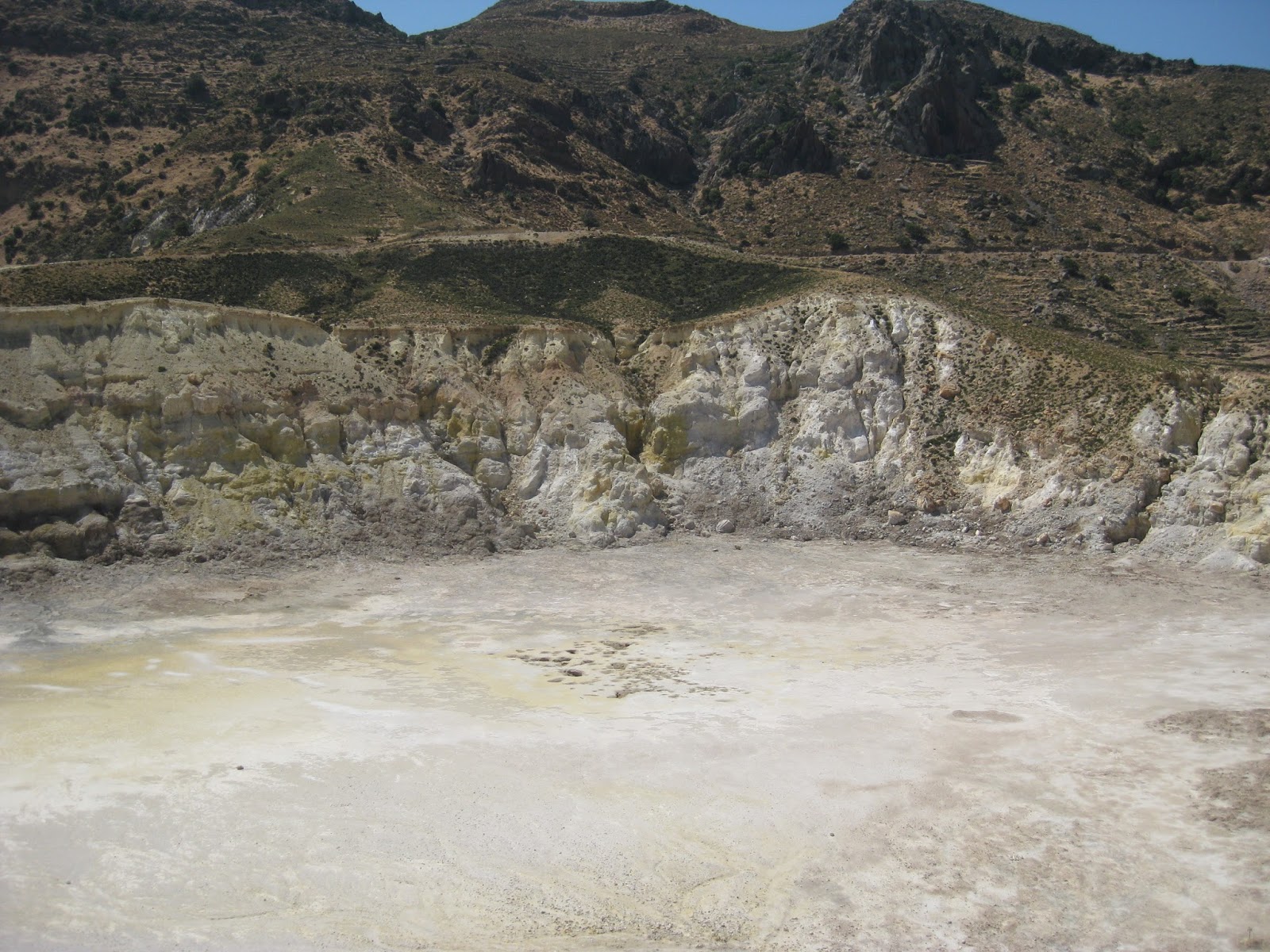
Volcano Caldera

Here come the day trippers!

Volcano Rob

Mandraki Paths

Mandraki meets the sea

I just found this incredibly beautiful ...

Kos - A Final Fragment


Monday, July 1, 2013—Kos Town, Kos, Greece
Made it to the beaches on the southwest coast of the island today. They are nice—they are big by Greece standards), sandy on go on forever (12 km, according to my Lonely Planet Guide). They were also pretty touristy, 5 euro umbrellas everywhere. It wasn't as bad as I thought it would be, though. Description made it sound like it would be a like a smaller version of the north coast of Crete: endless restaurants, hotels, and tacky souvenir shops. It was much wilder than that, though. Basically the beaches were backed mainly by fairly rugged scrubby mountains, featuring large swaths of junipers; the beaches reminded me of the much smaller ones on Gavdos. As I feared, though, the wind was up a bit, which made things a touch less enjoyable than they'd have been on a really good day. Still, I enjoyed myself. It was nice to get out of town, if nothing else …

Overall, though, I'm burned out on this island. It's just was too touristy here. It's been an interesting experience (which I've handled a lot better than I thought I would), but this is not why I come to Greece ...

[I got side-tracked and never got back to this entry—so I'll leave it a it stands.]

Paradise Beach, Southern Kos

Walking east (more or less) from Paradise Beach


While hiking in Kos I came upon this derelict Jewish cemetery. It obviously hasn't been looked after in a long time: it's full of weeds, headstone have fallen or been knocked over, etc. I have run into several of these in Greece and they never fail to tear at my heart. The reason of  course why they're abandoned is that the Nazi killed or drove off most of Greece's Jewish community during World War II.  The sorrow of these places is immense to me. I really don't know how to deal with it: they simply represent too much pain and loss to be processed ...

(Really) Creepy statue of Hypocrites I ran into on Kos

Friday, July 5, 2013

Map

This might help orient people reading this ... I'm on Halki (just above Rhodes) as I post this.


More Kos


Sunday, June 30, 2013—Kos Town, Kos, Greece
Didn't get out to the beaches today like I planned, for a couple of reasons. First off, I forgot that it was Sunday, which means a restricted bus schedule. I also wasn't feeling so hot when I woke up. I drink so little these days that my big night out—three drinks—actually left me with a mild but very persistent hangover, which meant that I got a late start and was moving pretty slowly. I decided instead to hike 3 km inland to a famous archaeological site called Askipieion, which is associated with Asclepius, the god of healing. It was also the site of a medical school where Hippocrates’ teachings were followed. It was a pretty interesting place. It was very hard to understand what I was seeing, though. Greek archaeological sites, even big important ones like this, tend to be very poorly explained. The site goes back to Minoan times and was used for various purposes right up until the early Christian era. Mostly what I was seeing was a jumble of material going back to the 2nd and 3rd centuries BC to later Roman times; like I've said, though, untangling what I was seeing was pretty difficult. I did get a lot of good pictures, though, to use to try and figure things out later. I also can use some of the shots in my archaeology class this coming semester …

The site aside, I glad I went there for the walk: it gave me a chance to explore a tiny bit of this island's inland areas, which are considerably different than those of the other islands I've been to. Like Patmos, this is a very rich island; it obviously has a lot more water that most of the Dodecanese. Other than this generally richness, though, it doesn't look at all like Patmos—the landscape is softer, more rolling and the colors are different. Patmos has the orange pinkish hue about it, whereas this place is more about saturated yellows; it reminds me of deeper, more intense version of parts of coastal central California (it's as if this place demands to be painted in oils whereas watercolors would render California more accurately). Like Patmos, though, light is a huge factor here: in both places it seems to have substance all its own; it's almost like another thing, trees, water, light … It seems like something you can reach out and touch, feel slip thru your fingers …

Since it has a lot of water it's not surprisingly more wooded than other islands. Even on my short walk today, which only got into the foothills, I was running into pines, cedars, junipers and other species I wasn't sure of. There are also more wildflowers here than other places in these islands (I bet this place is amazing in this regard in the spring when everything is in bloom). There also just more plant coverage in general. No place here I've seen (and I've seen a lot of the coast from the boat that brought me here) has that scrubby patchy look of Leros and so many other Greek islands I've been to. Though I've only seen the edges of the island's agricultural regions, based on what I have seen, this looks like a great place to be a Greek farmer. My guess is that the agricultural productivity here has got to be many fold a lot of the other islands …

 (More on this subject later. Tomorrow I'm going on my beach trip, which will have me cross a big chunk of the island. I should have much more info by tomorrow evening …)

Notes: Tourist Crowds of Kos
Last night I ate dinner at an outside table at a restaurant that was in the very heart of the tourist region, in one of the narrow twisty alleys of the old town. The tourist throng was amazing, in both their numbers and their movements. Only in Waikiki at the absolute height of summer have I seen that many vacationers in one place (that many in relation to the size of the place—Waikiki's considerably bigger). What I found most amazing was their interest in the banal shops that are everywhere here: except for some of the teenage girls looking at clothes, most of the them seemed interested because there was nothing else for them to do really but check them out: it was like they had to be interested or there was no reason for them to be there (of maybe here in general). I wonder if they ever wonder why they came here, if they ever wonder if they're really having fun or not …

General Notes:
Bought a boat ticket today to Nisyros, the next island to the south. It's going to be the exact opposite of this place: it sees only a fraction of the tourism of Kos. The main reason people go there is that the island is basically an active volcano and it's possible to hike right to edge of it. This is the main reason I'm going there, that and I hear that there are some other good hikes there as well …

After Nisyros I'll be heading to Tilos, mainly because it's supposed to have some of the best hiking in the Dodecanese. It's also supposed to be pretty far off the beaten path, which is definitely is appealing to me after the tourist crush of Kos …
Part of a reconstructed Roman Villa - Kos Town

My main Greece guide meets Ancient Rome - Just thought this would be a cool shot

Part of a Roman floor mosaic - Hard to get all of it in one shot, but it's really cool


Interior of Kos - Reminds me in places of Central California

Kos Town - From the ferry

Not a good photo of me on the Ferry off Kos (I look like The Dude on a bad day)

Kos - First Impressions


Note - I'm posting from cafes etc. with Internet connections that are slow - too slow for pictures, for the most part. I'll post a mess of photos as soon as I stumble upon a better connection or someplace where I can plug in and my lame battery is not an issue.

Saturday, June 29, 2013—Kos Town, Kos, Greece
Took a hydrofoil here today. Those things are fast!—I made it here, even with a stop in Kalymnos, in only about an hour and a half (they're also kind of expensive, 21 euros). I found a room just off the main part of town for thirty euros a night. This price includes breakfast. Given this, it's not a bad deal, especially considering how expensive this island is reputed to be. Even so, I will no doubt be spending more money here than I want to—the island just exudes expensiveness.

Back to the place I'm staying. It's one of those wonderfully weird Greek guest houses that can only be stumbled on by accident or by its proprietress (it's always older women who run these things) coming and grabbing you when you at the docks (which is what happened to me here). My room is this tiny little thing with two double beds a wardrobe and an old TV jammed into it. It's little balcony opens out onto the balconies and back windows of several other buildings, all of which are closely packed together. The bathroom is down the hall—and it's pretty amazing. It a combo bathroom/laundry room. Next to the toilet and the big American-style tub (huge by European standards) is a large washing machine. What's really bizarre it that they've got the washer draining into to toilet—there's a pipe with soaping water attached to the bowl (they've actually altered the bowl so the pipe can sit in it when the cover's closed). The place has also got thin walls and the rooms these odd doors, the top of which are smoked glass. When these doors are shut, even as quietly as possible, the whole building seems to be rattling. Added to this, the walls in the hall, the laundry room, etc. are adorned with Byzantine religious iconography. Almost as a kind of counterpoint, my room features an erotic photo of a pretty model-type couple embracing (so tasteless that it's almost pornographic). On the wall across from this is a needlepoint of young lovers embrace with a sunset backdrop. Amazing …          

I got in pretty early today, a little after noon. So I've had plenty of time to wander the town. It's a typical Greek island city, pretty, but really not all that different from, say, Hania or Rhodes Town (structurally it's nowhere near as interesting as those places). It is newer. A big earthquake leveled the place in 1933 so it lacks a lot of the old Venetian architecture and twisty alleys found in other Greek cities (though it does have the remains of a Knights of St. John Castle right in the middle its waterfront). Because of this is feel more spacious and relaxed. Still, it's filled with stalls selling the same old stuff you can get anywhere in these islands, as well as tourist restaurants that might as all have the same menu. The town is loaded with archaeological sites (two of which I explored today), but it's beaches look very mediocre (they're also fairly crowded—I seem to be back into the German tourist zone). So far I'd say this place is a mixed bag …

I feel like I've pretty much seen everything that interests me in town (unfortunately the archaeological museum is closed down, indefinitely). So tomorrow I think I'm going to take a bus to check out the beaches of the southwest of the island, either that or one on the north coast. I'm going to be here for two more full days, so I'll probably end up hitting both places either way. So far I'd say this place is EXACTLY what I expected it to be: pretty, touristy, and ultimately an island worth checking out for a short period, but not my style for any length of time. The main thing that bugs me about these kinds of places is that they really could be any beachie place in the world. Kos Town, for example, might as well be Rhodes Town or Biarritz or even Waikiki … I’m in Greece, but as long as I'm in this town that doesn't really matter: I'm in Beach Vacationland—that's the fundamental baseline I'm dealing with …

Since I've be eating in the last two nights I'm going to splurge a little bit on dinner tonight. There's a place called Elia's that Lonely Planet raves about, an oasis in the middle of the tourist district. I hunted it down this afternoon (it blended in really well—I passed it three times before I figured out it was the place I was looking for). It looks ritzy, but the prices weren't too bad. Then I plan on heading over to someplace called the Bittersweet Music Bar (or maybe it was “Lounge”). Mainly because it looked like a pretty cool place to hang out and I like the minimalist drum-and-bass tracks they were pumping out (it's Saturday night, though, so I may find a way less mellow scene tonight).

Notes on Leaving Leros:
As I watched Leros flow by me on my way to Kos I learned a lot about its geography. It's a harsh looking place. High mountains coming directly out of the sea, featuring almost nothing in the way of coastal flatlands or even beaches: surf striking rocky shores for miles. Dry landscape, scrub vegetation, which looks like it would even have a hard time supporting much of a goat population. Little in the way of settlement. It looked like it would be hard, unrewarding hiking. Kalymnos, the island just to the south of Leros, looks like an extension of this landscape. This makes me think that I made the right decision in exploring Leros lightly and skipping Kalymnos altogether. I only have so much time and money and I can't do everything. So far my instincts seem to be spot on …

General Notes:
My ankles and knees are really sore. I need to stay off my feet for the next few days, as the next two islands I'm planning on heading to—Nisyros and Tilos—are back-of-beyond places that are going to be all about hiking.

The wind that came up in Leros yesterday is blasting a way here as well. It's keeping things cool, but kind of screwing up the beaches. Hoping tomorrow won't be a windy, sandy mess.

Been having lots of weird intense dreams the last few nights, about nothing that at least directly has anything to do with Greece, featuring people from back home, in some cases people I haven't really thought much of in years. Have no idea what's causing them. Not too concerned.

Leros Thoughts


Friday, June 28, 2013—Alinda, Leros, Greece
Realized today that I've hit a bit of a wall. Like I mentioned in my last entry, yesterday I felt like I really needed a day to recharge. Today I've been feeling the same way. I woke up today, after about nine hours sleep, feeling totally wiped out. I knew it was going to be a minimalist day from then on out.

I did manage to climb the hill up to Pandeli Castle, which looms above the over side of Alinda Bay. It was interesting. The bulk of the castle was destroyed at various times, so most of what's up there is a reconstruction but it felt pretty authentic. More interesting than the castle itself was the museum next to it. The museum is culturally only tenuously connected to what had gone on with the castle. Mostly it houses examples religious iconography, which were quite interesting, mainly because the guy working in the museum explained them really well. He was a Greek-American from Texas, so he understood how to translate Greek Orthodox traditions for outsiders. Other than the museum all I managed to do was buy a boat ticket for Kos (I leave tomorrow at 10:20 AM).

I really haven't seen much of this island, just the castle and the towns strung along this part of the coast. Normally this would bug me, but I hadn't really planned on coming here anyway. Also, based on descriptions of this place and what I have seen there's really not that much that interests me here: I'm using this island mainly as a relatively inexpensive pit-stop. That said, if I had a bit more money to burn, I wouldn't mind staying here a couple more days, mainly because I haven't quite figured the place out and I don't like leaving mysteries behind me. That said, I do think I get why this isn't exactly a hot destination: it doesn't have the wildness and breadth of someplace like Crete, while it also lacks the glamor, facilities, and style of places like Rhodes and Kos. It feels off the beaten path, but not necessarily in a good way … 

 Today the wind kicked up, making it a pretty lousy day for the beach (which is mainly what this place has to offer). Because of this there hardly seemed to be anyone around. Or at least that's what I thought was going on. To save money I ate in again tonight, taking advantage of the rarity of having a kitchen. After eating an early dinner and then taking an unexpected nap (I just crashed), I decided to head out and get a drink somewhere just to get out and mingle. Alinda, though, was empty; it's a Friday night and virtually every restaurant and bar was deserted or nearly so—and this is the tourist center of the island. I'm beginning to think that a lot of the people I saw on the beach yesterday were local Greeks who didn't come out today because of the wind. If my observations are correct, this place is really dead. I wonder if this is because of the state of the European economy or is this place always like this (I doubt the latter seriously: there are too many restaurants, hotels, etc. to have arisen for no reason). Some of the businesses here are closed. Maybe this place is really hurting. Or maybe things don't get going here till later in the summer. It was so dead that I decided to buy a beer and head back to my guest house. I didn't want to sit in some bar literally by myself …
Onward to Kos …

Pandeli Castle (or maybe the Castle Anthrax - "In the name of King Arthur open the door ...")

Monday, July 1, 2013

Patmos From Leros and Leros

Thursday, June 27, 2013—Alinda, Leros, Greece
Left Patmos at about two this afternoon (it’s a little after five now), on a local catamaran, (as opposed to the big inter-island ferry). Still annoyed by Patmos. As I've mentioned there was just something a little off-putting about the place, despite its great beauty. Spend my last day there hiking up to the old acropolis (of which there’s almost nothing left except some fragments of square-cut stone block walls). Then I hiked up to Hora, a town over-looking the port of Skala. It’s mainly famous for an old, massive monastery (which looks more like a Knights of St. John castle than a religious building). It was a great walk, fascinating environmentally: it’s such an abrupt rise in altitude that only a few minutes into my hike (which I did partially on trails and footpaths and the main road) I found myself in a forest, which was dominated by pines and featured cedars, scattered junipers, and eucalyptus (dumb imported Australian trees)—it amazes me how quickly the plant communities can change on these islands.

The monastery turned out to be closed by the time I got there. This didn't bother me too much, as religious stuff interests me almost not at all (though I would have liked to examine the architecture of the monastery, which looked really cool from the outside); I mainly went for the hike. I did wander around the old twisting medieval streets of Hora for a while, which was interesting. The place was a touch too touristy for me, though, so I was only there for an hour or so before heading back down to Skala.

Overall I'm pretty torn concerning my Patmos experience. On one hand, it might be physically the most beautiful Greek island I've been to. But culturally it had almost nil to offer. Greek, British, French, Italian, and some American tourists crowding narrow town beaches. Over-priced mediocre restaurants—nothing original about any of them (they might as well have had the same menu). Scooters and cars forever zooming past you (lay your head on a town beach and they move by literally feet from your skull). It’s almost as if the place culturally cancels out its immense environmental pluses …

OK, Leros. Like I said, I just got here a couple of hours ago. All I've done is find a place to stay (a really cool place, big, with a kitchen for only twenty-five euros a night) and wander around town, and get some stuff at a supermarket to make some dinner). Basically this town is one of three that hug a little section of the island’s coast. Alinda, in fact, might be the narrowest Greek town I've been to: it literally clings to the marginal beach that rims Alinda Bay. Though it’s just the next island over, environmentally this place looks much more like Crete than Patmos: the lemon yellow light has returned, as has the drier, more rugged landscape. The town feels a little like a low-rent version of Patmos, though: the same narrow strip of sand, basically interchangeable nightclubs and bars, traffic forever zooming by …

There’s not all that much I came here wanting to see. Apparently this island has one of the cooler medieval castles in the islands (which is saying quite a bit, because there are a lot of good ones around here). I plan on checking that out tomorrow. I’m also going to look over the towns to the south. I may stay another day or so after that if I can find some cool, more far-flung beaches. If not, I’ll be off the following day. To where I’m not yet sure. I will keep moving south, though (I've decided to give the smaller islands up here—Lipsi, Arki, etc.—a miss, mainly because up close they don’t seem all that interesting, and also because I know they’ll be a bit expensive) …
           
Notes from the Northern Dodecanese:
As soon as one gets north of Karpathos prices start getting higher (and higher). The islands also seem to lose that wonderful semi-anarchic quality that Crete has: there just seems to be more rules up here. Beginning to realize that I like Greece, but I love Crete; it really has everything I want from Greece: sun, sea, great (challenging) trails, interesting culture … And again, it’s also a lot cheaper than up here. Glad I’m heading back there, perhaps sooner rather than later …

Noticing that there’s a nationality change among the tourists here compared to Crete: the Germans largely drop out and are replaced mainly by English, French, Italians, and, to a much lesser extent, Americans. Coming to the conclusion I like Germans the best of this lot. They may be taciturn, frowning bastards, but in their own weird way they’re freer. Plus, if nothing else, they’re unobtrusive: they blend in with their environment better than the English do, who tend to English-up every place they go. French and Italian people mostly just seem to want to hang out with their own kind, which makes then almost non-factors, except that they’re taking up space that could go to less ethnocentric travelers. Some of the more interesting travelers I've met in Greece have been English, French, and Italians in Crete: it’s almost as if that island attracts the rebels, the more interesting offspring of these countries …

Now that I've got a nice place to stay I’m going to have a off night, I think, a night to be alone and recharge. I need to read, write, watch bad Greek TV … Writers have to get away from people to get closer to them, pointed out Lawrence Durrell. At least for short periods here and there that is very true …

Beach out in front of where I was staying ion Patmos

Skala, Patmos

Forested Area Above Skala